Saturday, October 13, 2012

2nd Bassoon Audition 2.0


I've been thinking about the 2nd bassoon audition we held last month.  It was interesting to compare and contrast it to the one we held in January.  Many of you have read my post about that audition.

In this post, I'd like to offer some follow-up comments. In particular, I'd like to focus on the perspective I gained by comparing notes with the non-bassoonists on our audition committee. 

Remember that it's usual for an audition committee to comprised of a majority of people who DON'T play your instrument.  Their perspective is somewhat different from that of a specialist and they potentially hold a majority in a vote.

For a candidate, then, it's vital to seek out opinions from non-bassoonists in preparation for an audition and try to weed out bassoon-specific problems from your playing.

Here are some of the recurring themes about some bad bassoon playing habits observed by my colleagues.

1. My colleagues wonder why the bassoon mechanism is so noisy!  Marriage of Figaro sometimes sounded like it had its own castanet accompaniment. Air leaking from the embouchure was also distracting.

2. Some candidates, including several in the semi-final round seemed incapable of playing a sustained musical line.  Lots of phrases in the Mozart Concerto were broken up by choppy articulation and accented downbeats.

3. Related to the above was a preponderance of clipped phrase endings, especially in the Concerto.  All phrase endings the first movement exposition are quarter notes.  So many people chopped them off, paying no attention to the finish and resonance needed for a graceful phrase ending.  I think this was partly due to nerves and the fact that most of the offenders were already thinking about the next phrase, forgetting to finish what they started.  Remember, have to paddle with one hand and bail with the other!

4. Double tonguing that sounds like machine gun fire.  My colleagues don't understand why this is necessary!  In the Marriage of Figaro, certainly Mozart's intention was simply to double the cello line in the bassoon parts, not to create a special effect.  Once double tonguing is learned, it needs to be musical, not a parlor trick.  In Figaro, the sound of the articulation should be like the fast bowing on the string you hear from the cellos.

5. Same vibrato for each excerpt.  Many players neglected to examine how they were using vibrato to add to the character of each excerpt and instead opted to use an unvarying default vibrato on everything.  Why would you use vibrato for the Tannhäuser Overture at all!  You are playing with clarinets and horns exclusively (non-vibrato instruments except in just a few parts of the world).  Furthermore, the Bolero solo requires a different kind of vibrato from a tutti passage in Brahms' Third Symphony.

6. Inability to change styles for each excerpt as needed.  Many of the candidates displayed no discernable change in style whether it was Mozart, Ravel, Tchaikovsky, etc.  Flexibility and versatility are essential skills needed in orchestra rehearsals where a conductor may ask a player to execute a musical 180˚
turn on his/her interpretation of a piece a few seconds after playing it for the first time.

7. Related to the above -- inability to resist the "pull" of middle-of-the-road playing, e.g., Figaro all played at "mp", Tannhäuser played "mp" at an Andante tempo with accented articulation.  These excerpts are easy to play when you ignore the dynamics and tempos indicated!

Again, these were comments I gathered from colleagues, some of them things a bassoonist might gloss over (key noise, rough double tonguing, etc.).  I think they are invaluable observations, ones to add to the list of priorities for the next audition you take.

Thursday, October 11, 2012

The Musical Back Burner


Pieces To Keep On The Musical Back Burner

The repertoire for this month's Cleveland Orchestra concerts contains a few pieces with some devilishly difficult technical passages. While the pieces I'm thinking of don't make it to the "Top 25" list of frequently asked audition material, I'd venture to say that most of us would need plenty of lead time to learn them for performance.

The first piece is Daphnis and Chloe, Suite #2. The Final Dance or Bacchanal contains some nearly unplayable passages for the principal bassoon.   


By using some harmonic fingerings the passage becomes easier to negotiate, but given the breakneck tempo usual in performance, it's still almost unplayable.  Certainly not something you could work up in a week's time never having played it before.

Likewise with this passage from the Russian Dance from the 1947 version of Stravinsky's Petrushka, which we're performing this week.


When taken at ♩=116, this is really challenging, too.  In fact, in the original 1911 version of the piece Stravinsky broke this part up, writing it for two bassoons alternating the triplet/eighth figure -- one plays one beat while the other rests -- to create a continuous line. He knew this was hard!

BLOG SUBJECT INTERMISSION

Petrushka gets involved in a lot of violent acts during his short ballet.  He's kicked by the Charlatan, he hurls himself into and breaks through a portrait of the Charlatan on canvas, and gets beat up by the Moor who finally slays him with a sabre.

It occurred to me this week that Petrushka the puppet reminds me a lot of another, more contemporary character. 


Back to the blog. . .

By the way, the Daphnis passage cited above can be simplified by giving the second bassoonist the second group of 16ths to play in each 16th passage.

Not wishing to encounter nasty surprises like these passages, I've compiled an informal list of passages that need regular technical maintenance work so that they can be ready when needed.  Warm and serve. . . 

These are passages that I'll try to work on during one or two practice sessions each month when I have time.

Here's a partial list:

  • Till Eulenspiegel tutti passages
  • Daphnis and Chloe Suite #2
  • Petroushka Russian Dance
  • Firebird Infernal Dance
  • Mozart Symphony 35 last movement
  • Stravinsky L'Histoire du Soldat Ragtime
  • tutti passages for other Strauss tone poems
  • Sorcerer's Apprentice tutti passages 

What's on your list?

Thursday, September 27, 2012

Cleveland Double Reed Activity


STEES RECITAL


My recital last week went pretty well.  A good number of people showed up -- some bassoonists, of course, and a large group of people from my church.

Randy and I are captured in action above.

I raised over $600 for Team Boomer!  Thanks to all who have donated.  I've almost reached my fundraising goal and the marathon is still 6 weeks away.


FRANK ROSENWEIN PLAYS STRAUSS

This Thursday, Friday and Saturday, Frank Rosenwein, our Principal Oboist will play the Strauss Oboe Concerto with the Cleveland Orchestra.  This is one of the great wind concertos.  I am playing the 1st bassoon part, so I'll have a good seat for hearing Frank's beautiful oboe playing.


JOHN CLOUSER PLAYS MOZART  

The double reed fun continues next week when John Clouser will play the Mozart Bassoon Concerto.   John played the piece with the Orchestra several years ago at the Blossom Music Center.  This time it will be in Severance Hall on October 4th and 6th. The rest of the program is very colorful -- Daphnis and Chloe Suite #2 and Incidental Music from A Midsummer Night's Dream by Mendelssohn.

I hope some of you can attend these events! 

Wednesday, September 26, 2012

Our New Second Bassoonist

On Monday of this week we held auditions for Second Bassoon again.  The first time was unsuccessful.  I've written about this here and many of you have read it.

This day was different.  We hired Billy Hestand. 


Billy plays Principal Bassoon in the Brooklyn Philharmonic and freelances in New York City.  He has also played with the New York Philharmonic, the Orchestra of St. Lukes, the New York City Opera and New York City Ballet.

Billy did his studying with Patricia Rogers and Kim Laskoski at the Manahattan School of Music.  He also studied with me at the Interlochen Arts Academy.  I'm very excited and proud to have him join us!

I will write more about this audition in the next few days.  In the meantime, I'm surveying a few of my colleagues on the committee for trends and such that they noticed in the bassoon playing we heard.

I felt the general level of playing was better this time around.  Most of the candidates played with a beautiful sound, fewer were strident or militant in their phrasing, articulation, etc.

Meanwhile, I think we're all happy to have the process behind us and excited to have Billy join us.

Thursday, September 20, 2012

Benefit Recital

RECITAL THIS WEEK


I'm playing a recital this Sunday.  Here are the details for any local people interested in coming:

Sunday, September 23, 2012, 3:00pm

The Federated Church
76 Bell Street  Chagrin Falls, OH 44022
(440) 247-6490

Program:

Hindemith SonateSaint-Saëns Sonate
Willson Osborne Rhapsody
Weber Andante and Rondo

my transcriptions of three works by Manuel de Falla

The recital is free with a free-will donation to the Boomer Esiason Foundation. I've written about my run for charity in a previous post.  The recital will help raise money for the Foundation's efforts to fight Cystic Fibrosis.  My niece, Allie has the disease.


 A MULTI-PURPOSE RECITAL

The recital will serve several purposes. 


  1. I thought it would be a great way to combine music with my fundraising for Team Boomer just six weeks away from the New York City Marathon. 
  2. I realized it had been quite a while since I'd played a recital of "standard" repertoire.  My recent students had heard me play mainly new or off-beat repertoire. So I asked them to choose the rep for this recital with the proviso that they not choose anything that was ridiculously difficult!
  3. CIM is not an appropriate place for a benefit concert of this type, so why not give it at my church where I have so many supporters!
 I hope some of you can attend!


Thursday, September 13, 2012

Running along the Danube

I use running during tours to relax, stretch out and get some aerobic activity in while seeing an interesting part of a city.  Because of the demands of the tour schedule, much of it must be done in the morning before travel or rehearsal.

Many European cities are situated along major rivers.  Much of the time there are dedicated paths along them for bikers, walkers and runners.

During our stay in Linz I ran along the Danube using the Danube River Bike Route

This is part of a route that stretches from the Black Forest in southeastern Germany to the Black Sea.  I've run along other stretches of it before in Vienna and Belgrade.

The section from Passau, Germany to Vienna (about 200 miles) is considered the best part of the route.  Here there are no roads to share with vehicles.  In some places there are paths on both sides of the river. 

In the Linz area there are kilometer markers telling you how far it is to the next city, how far to a place for public showers, signs for hotels, B & B's, campgrounds, etc. that cater to the bikers

To get to the path I just headed to the river from our hotel and crossed using a big railroad bridge.  Great views of the city, countryside and Danube all around.

Even early in the morning there were lots of people out biking and exercising.  I logged a total of 24 miles in two days on this path and felt quite safe running here. 

This was not the case in Belgrade, however. After the trail leaves Austria, the path is not marked with attractions and bikers must use city streets from time to time.  We ran through an industrial shipping area in Belgrade that felt rather sketchy.

Bruckner in Linz


Our time in Linz was devoted to the making of a DVD of Bruckner's 4th Symphony.  The recording will be put together from the best parts of two concerts we gave in the basilica at the abbey of St. Florian, several miles outside of Linz.

Some Sight Seeing

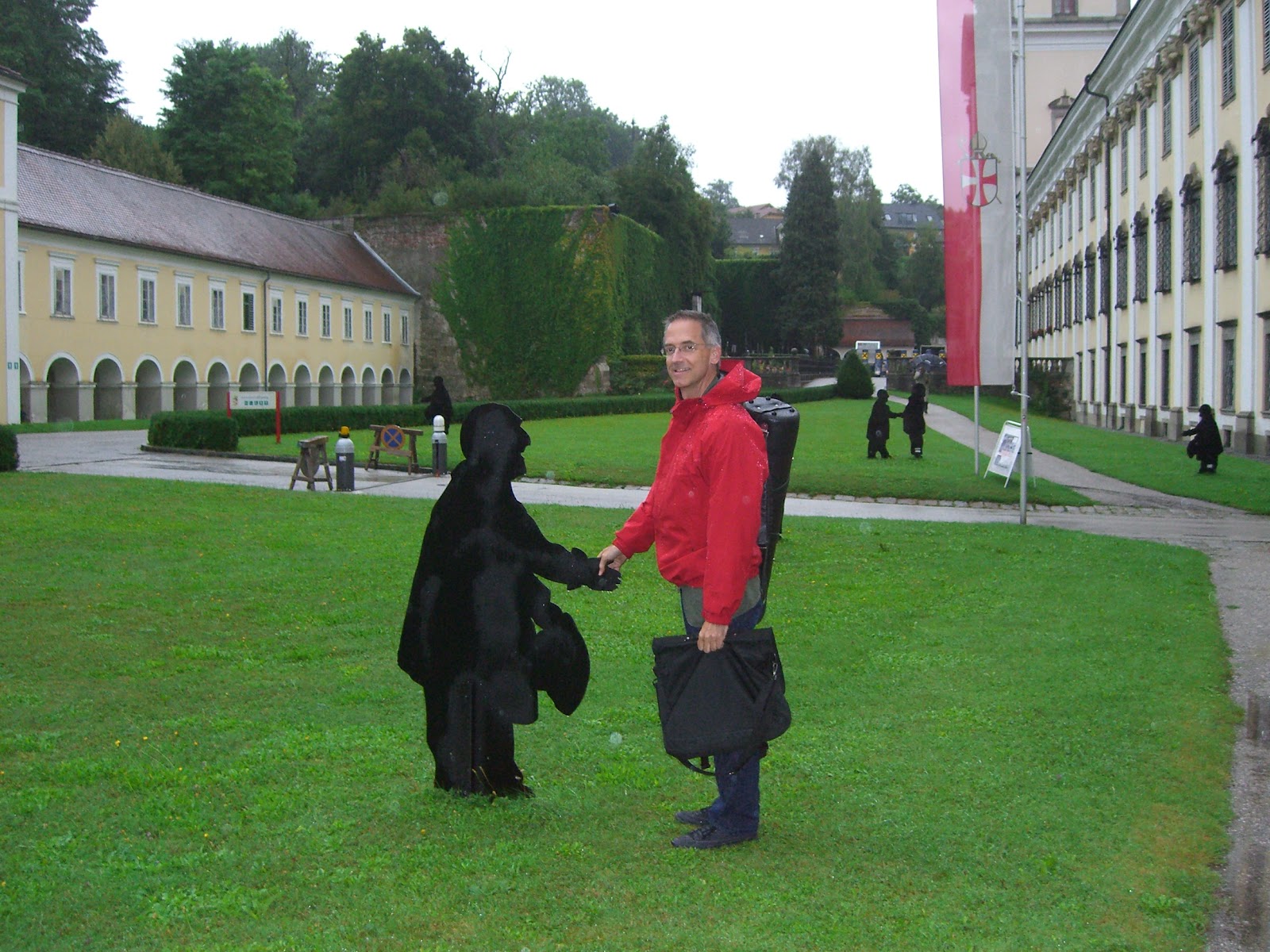
On the way in to the church I was greeted by Bruckner himself!


He was the organist here.  In fact, at his request, he was buried in the crypt below in a metal coffin directly under the organ, where he could feel the vibrations.


No trip to the church is complete without a visit to the crypt. Along with Bruckner are buried many of the past abbots of the monastery and some nobles, including a former queen of Poland.

When the church was being built in the 1200's, workers discovered the remains of an older Christian community when digging the foundation.  These remains (over 6000 bodies) are neatly stacked in an ossuary just behind Bruckner's coffin.


Readers of this blog are probably now thinking that I'm obsessed with death and graves!  Not to worry!  When I have free time on a tour I try really hard to find things that we don't normally see in the U.S.  I know of no graveside tributes to bassoonists in our country, nor have I ever seen an ossuary next to a composer's coffin in the crypt of an American church!

Maybe next fall I'll visit the Funerary Arts Museum in Vienna and give you all a full report!

Back to Bruckner!

Acoustics Make the Difference

Playing his music in this church is very special -- perhaps like hearing Wagner in Bayreuth.  The music makes more sense in the live acoustics of the basilica.  Bruckner is known and sometimes reviled for his baffling silences.  With several seconds of decay, the silences are soaked up by a lovely dissipation of sound in this place.

Knowing that Bruckner was a deeply religious man it's valid to suppose that the combination of full orchestra statement followed by increasing silence in the decay could be the sonic equivalent of prayer or supplication offered to God.

The Recording Sessions

About the sessions:  In order to maintain continuity between the two days of recording we were encouraged to be sure to wear exactly the same concert attire for both nights.  No haircuts in between sessions!  If you wear reading glasses to play, be sure you wear them on both nights.

For a cleaner visual, we were discouraged from bringing cases, water bottles, etc. on stage.  Some did bring reed tools and smaller items, though. 

I refrained (for once) from using my earplugs.  Putting them in and taking them out could be distracting.  Also, we in the bassoon section avoided using our bassoon stands during rests.

We've performed the 4th many times already this year, so just the two performances sufficed for the recording.  No patch session.

Camera crews meshed uneasily with the performers on a cramped area in front of the altar.  Some cameramen asked for musicians to avoid certain poses so they could film rows of players unobstructed.  This was met with varying degrees of compliance.  In a stressful situation, it's hard enough to concentrate on playing well!

There was also a surprising amount of noise coming from the technical crew during the concerts.  I guess none of it will bleed into the soundtrack?

Reaction at the conclusion of each concert was interesting.  The audiences were appreciative, but not boisterous in applause, shouting, etc.  I think the combination of Bruckner and a sacred site gave a more muted, reverent response than what we'd experienced elsewhere.

Bruckner in St. Florian

This was certainly not the first time anyone has recorded a Bruckner work in St. Florian.  Here are some examples.

We were there in 2006 and recorded the 5th:
http://www.youtube.com/watch?v=rprh94GS0gw

Here are two famous recordings of the 8th made in the church:

Pierre Boulez and the Vienna Philharmonic
http://www.youtube.com/watch?v=KUNzZw5RQXs

The Vienna Philharmonic with Karajan
http://www.youtube.com/watch?v=2i_Ja0FTCKY