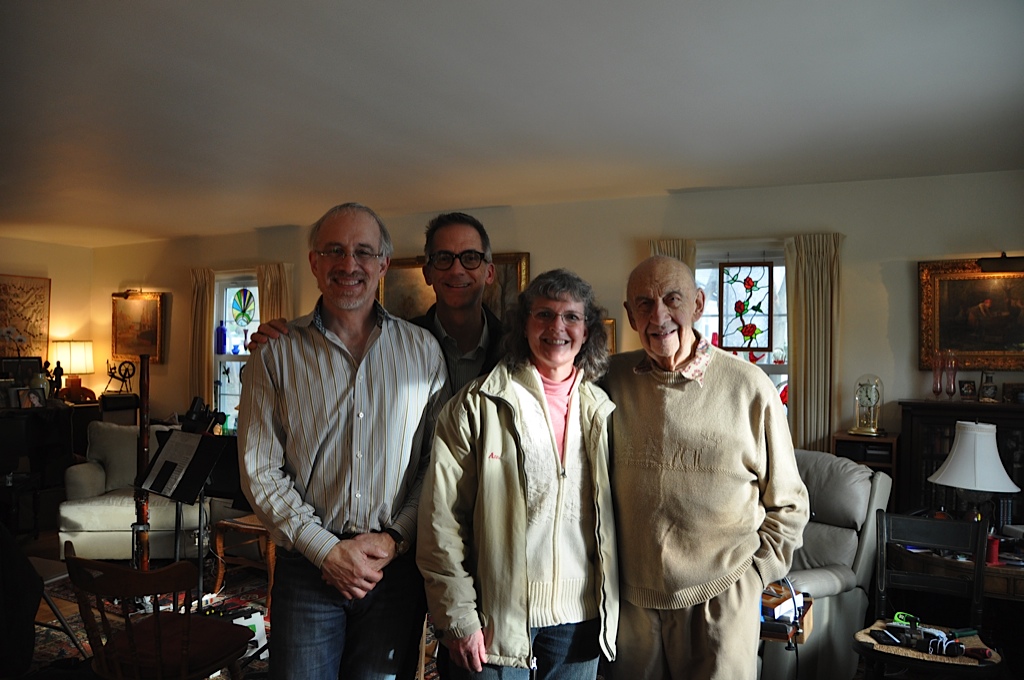
The past few weeks have been really nice around here. I've had some time off and had the pleasure of seeing and hearing some former students at the house. It's really nice to see them again and hear how they're doing. One of the frustrating parts of being a teacher is that day when they graduate and leave for other parts, so it's fun to have a visit from time to time.
It's also fun to see what areas of their playing have improved since I last heard them.
Perhaps the best skill a teacher can impart to a student is to help the student learn how to teach himself. Give a man a fish/teach a man to fish. . . .
However, this skill is not magically bestowed upon graduation. It is a life-long pursuit. No one can develop this skill on her own. Those who continue to grow as musicians seek out help from former teachers or other mentors for occasional feedback after the end of formal study.
This may come in the form of periodic get-togethers with a former teacher, playing for colleagues, listening to recordings of yourself and others or even just attending concerts on free nights.
Recording "Teachers"
Upon graduation from college I used my time as a record store clerk to listen to recordings in the store to learn new repertoire and study interpretations by different artists. I found I learned the most from listening to singers and pianists.
Perhaps because I have a passing knowledge of German, I learned the most from German artists like Dietrich Fischer-Dieskau, Fritz Wunderlich and Elizabeth Schwarzkopf. The art of the German Lied with its marriage of music and poetry and its intimate setting gave me valuable insights in interpretation, how to sing a line, how to color notes, etc. It also taught me to protect the "p" dynamic so my playing would have the requisite contrast and scope.
Pianists I listened to were Horowitz, Brendel and Pollini for various reasons.
Horowitz (who was still alive during this period) was a living link to the great pianists of the past like Rachmaninov, Busoni, Liszt, etc. His piano was voiced like no other and thus, yielded a sound that no other could elicit. His performances had an element of wizardry to them. I remember a performance of Liszt's "Mephisto Waltz" after which the piano literally shook for a few seconds. Did I see smoke coming from under the lid? He revoiced chords and occasionally altered the music in such a way that some of his repertoire was as much "Horowitz" as it was Liszt or some other composer.
Brendel provided a link to the core Germanic repertoire (Beethoven, Schubert, etc.) and older performers such as Edwin Fischer and Arthur Schnabel. His playing was (he just recently retired) profound, yet full of good humor. His touch was the most expressive I've ever encountered. I still remember his performance of the Beethoven 4th Piano Concerto with us a few years ago!
Pollini's playing is inspiring for its technical brilliance and faithfulness to the score. His passion for contemporary music balances his expertise with the core repertoire. His recording of the version for piano of Stravinsky's Petroushka is legendary!
(Blog post time out -- if some of these names are unfamiliar to you, I highly recommend you seek out their performances. If you are a classical musician, these are your forefathers!)
The Check-Up
Every couple of years I made a point of going to Rochester, NY to play for my former teacher, K. David Van Hoesen. Sometimes the things a teacher says take years for the student to absorb. The lessons on those visits helped cement in my mind things he brought up during my formal study with him.
Generally I'd bring an audition repertoire list to play or something I was recording for his reaction. He always seemed pleased to see me and would spend the necessary time with me to attack any problems I was having with the music.
I left with a more accurate assessment of what things in my playing needed greater attention.
Recommendations
I made those visits not only for help with my playing, however. I wanted Van Hoesen to have an updated impression of my playing every few years so he could write the most effective recommendation letter or speak most effectively about my playing when called upon to do so.
Teachers with long careers like his have so many students over time that it's sometimes hard for them to recall specific aspects of a particular student's playing 10 years or so past graduation. If you are a young professional reading this, would you want your teacher to write about how you played upon graduation or how you play now?
When I joined the Cleveland Orchestra there was a period of about a year when lots of former students were suddenly asking me for letters of recommendation. Some were students who had stayed in good contact with me and who had recently played for me.
However, there were a few I heard from who hadn't been in touch for 10 years or more. I refused to write letters for them because I felt I couldn't accurately describe their skills today.
John Whitwell, former Director of Bands at Michigan State University used to say to his students, "You write a new paragraph in your recommendation letter each day." That's good advice for musicians, for this world is very small and most people know each other through a myriad of connections.
Each year at CIM we read the recommendations written on behalf of applicants. I've come to know which teachers write meaningful recommendations and which ones don't.
Some teachers always write glowing recommendations -- and then you hear the student play. . .
Others write carefully composed letters that still present the student in a favorable light but don't boast or exaggerate. It is always interesting to note what's NOT mentioned in the letter!
When asking someone to write a letter for you, it's best to waive your right to see the letter.
That way the writer is free to compose a letter that's honest and candid. If you must handle the letter, make sure the writer has sealed it and signed over the flap of the back of the envelope before you get it.
Be courteous and provide your writer with an addressed, stamped envelope if the letter cannot be submitted online.