I use running during tours to relax, stretch out and get some aerobic activity in while seeing an interesting part of a city. Because of the demands of the tour schedule, much of it must be done in the morning before travel or rehearsal.
Many European cities are situated along major rivers. Much of the time there are dedicated paths along them for bikers, walkers and runners.
During our stay in Linz I ran along the Danube using the Danube River Bike Route
This is part of a route that stretches from the Black Forest in southeastern Germany to the Black Sea. I've run along other stretches of it before in Vienna and Belgrade.
The section from Passau, Germany to Vienna (about 200 miles) is considered the best part of the route. Here there are no roads to share with vehicles. In some places there are paths on both sides of the river.
In the Linz area there are kilometer markers telling you how far it is to the next city, how far to a place for public showers, signs for hotels, B & B's, campgrounds, etc. that cater to the bikers
To get to the path I just headed to the river from our hotel and crossed using a big railroad bridge. Great views of the city, countryside and Danube all around.
Even early in the morning there were lots of people out biking and exercising. I logged a total of 24 miles in two days on this path and felt quite safe running here.
This was not the case in Belgrade, however. After the trail leaves Austria, the path is not marked with attractions and bikers must use city streets from time to time. We ran through an industrial shipping area in Belgrade that felt rather sketchy.
Thursday, September 13, 2012
Bruckner in Linz
Our time in Linz was devoted to the making of a DVD of Bruckner's 4th Symphony. The recording will be put together from the best parts of two concerts we gave in the basilica at the abbey of St. Florian, several miles outside of Linz.
Some Sight Seeing
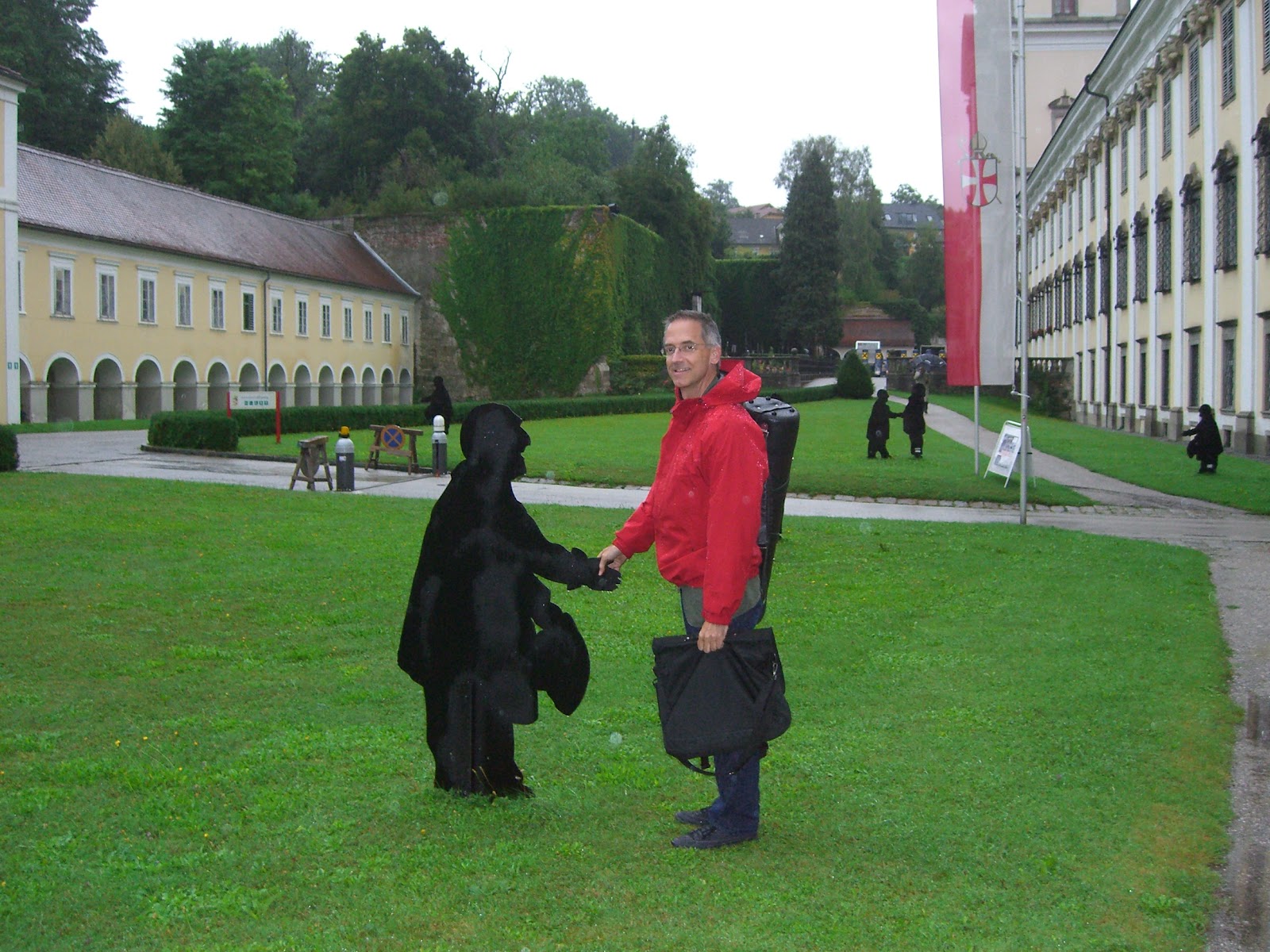
On the way in to the church I was greeted by Bruckner himself!
He was the organist here. In fact, at his request, he was buried in the crypt below in a metal coffin directly under the organ, where he could feel the vibrations.
No trip to the church is complete without a visit to the crypt. Along with Bruckner are buried many of the past abbots of the monastery and some nobles, including a former queen of Poland.
When the church was being built in the 1200's, workers discovered the remains of an older Christian community when digging the foundation. These remains (over 6000 bodies) are neatly stacked in an ossuary just behind Bruckner's coffin.
Readers of this blog are probably now thinking that I'm obsessed with death and graves! Not to worry! When I have free time on a tour I try really hard to find things that we don't normally see in the U.S. I know of no graveside tributes to bassoonists in our country, nor have I ever seen an ossuary next to a composer's coffin in the crypt of an American church!
Maybe next fall I'll visit the Funerary Arts Museum in Vienna and give you all a full report!
Back to Bruckner!
Acoustics Make the Difference
Playing his music in this church is very special -- perhaps like hearing Wagner in Bayreuth. The music makes more sense in the live acoustics of the basilica. Bruckner is known and sometimes reviled for his baffling silences. With several seconds of decay, the silences are soaked up by a lovely dissipation of sound in this place.
Knowing that Bruckner was a deeply religious man it's valid to suppose that the combination of full orchestra statement followed by increasing silence in the decay could be the sonic equivalent of prayer or supplication offered to God.
The Recording Sessions
About the sessions: In order to maintain continuity between the two days of recording we were encouraged to be sure to wear exactly the same concert attire for both nights. No haircuts in between sessions! If you wear reading glasses to play, be sure you wear them on both nights.
For a cleaner visual, we were discouraged from bringing cases, water bottles, etc. on stage. Some did bring reed tools and smaller items, though.
I refrained (for once) from using my earplugs. Putting them in and taking them out could be distracting. Also, we in the bassoon section avoided using our bassoon stands during rests.
We've performed the 4th many times already this year, so just the two performances sufficed for the recording. No patch session.
Camera crews meshed uneasily with the performers on a cramped area in front of the altar. Some cameramen asked for musicians to avoid certain poses so they could film rows of players unobstructed. This was met with varying degrees of compliance. In a stressful situation, it's hard enough to concentrate on playing well!
There was also a surprising amount of noise coming from the technical crew during the concerts. I guess none of it will bleed into the soundtrack?
Reaction at the conclusion of each concert was interesting. The audiences were appreciative, but not boisterous in applause, shouting, etc. I think the combination of Bruckner and a sacred site gave a more muted, reverent response than what we'd experienced elsewhere.
Bruckner in St. Florian
This was certainly not the first time anyone has recorded a Bruckner work in St. Florian. Here are some examples.
We were there in 2006 and recorded the 5th:
http://www.youtube.com/watch?v=rprh94GS0gw
Here are two famous recordings of the 8th made in the church:
Pierre Boulez and the Vienna Philharmonic
http://www.youtube.com/watch?v=KUNzZw5RQXs
The Vienna Philharmonic with Karajan
http://www.youtube.com/watch?v=2i_Ja0FTCKY
Wednesday, September 12, 2012
Salzburg
Next we took a train to Salzburg. The Cleveland Orchestra was booked for two concerts at the Salzburg Festival.
Salzburg is known as the town where Mozart was born and where he spent his early years when he wasn't on the road with his family playing for the crowned heads of Europe. We played in the Grosses Festspielhaus, just a few streets away from his house.
Featured on the two concerts were movements from Smetana's Ma Vlast, Shostakovich Symphony #6 and Lutoslawksi's Concerto for Orchestra.
We had a surprise when Krystian Zimmerman, the piano soloist for the Lutoslawski Piano Concerto cancelled at the last minute. After much frantic phone calling to find a replacement, the piece's performance was cancelled.
In its place we scheduled a repeat of the piece we commissioned and premiered a few days ago in Lucerne, Matthias Pintscher's Chute d'Etoiles for Two Trumpets and Orchestra. Mike Sachs and Jack Sutte, Principal Trumpet and Second Trumpet were called back into action for this performance.
The Salzburg Festival is one of the most exclusive music festivals in the world. It was started in between the World Wars by prominent German artists such as Max Rheinhardt and Richard Strauss.
Along with us, the lineup for this year's Festival included a production of Handel's "Julius Caesar" with an all-star cast. An old friend of mine, Ed Deskur, was playing horn in the Handel orchestra.
On one night we both had concerts (the Festival has several concert venues in the same complex). However, Ed only played at the beginning and end of the opera. Julius Caesar is a FIVE HOUR opera, so he had lots of free time in between. He snuck backstage at our hall and met up with me during my intermission. He ended up staying to hear the rest of our concert and then went back to play the last few minutes of his!
The next day, we got together and hiked up to the castle on the mountain overlooking Salzburg.
During our stay in Salzburg, I also had a chance to see another friend, Stanley Hale. Stan lives outside of Vienna and caught a train to come up and spend an afternoon with me. We hiked up the Kapuzinerberg and then had dinner.
The orchestra left the next morning for Linz. Since it was a day off, I stayed an extra day and went for a long run on the path by the Salzach river that morning.
After the run I went to my favorite coffee bar for an espresso and some breakfast.
The Salzburg Cafe Primadonna is not the fanciest coffee bar in Salzburg, but it is quick and the coffee is expertly made. The espresso is complex, rich, but not burned tasting like many places. It doesn't adhere to the Starbucks trend of extreme dark roast. Therefore, you don't need milk of any kind to cover the burned taste.
It is centrally located just off the Linzergasse just across the bridge from the western part of the Old City.
Later that evening I boarded a train for Linz, our next stop on the tour.
Salzburg is known as the town where Mozart was born and where he spent his early years when he wasn't on the road with his family playing for the crowned heads of Europe. We played in the Grosses Festspielhaus, just a few streets away from his house.
Featured on the two concerts were movements from Smetana's Ma Vlast, Shostakovich Symphony #6 and Lutoslawksi's Concerto for Orchestra.
We had a surprise when Krystian Zimmerman, the piano soloist for the Lutoslawski Piano Concerto cancelled at the last minute. After much frantic phone calling to find a replacement, the piece's performance was cancelled.
In its place we scheduled a repeat of the piece we commissioned and premiered a few days ago in Lucerne, Matthias Pintscher's Chute d'Etoiles for Two Trumpets and Orchestra. Mike Sachs and Jack Sutte, Principal Trumpet and Second Trumpet were called back into action for this performance.
The Salzburg Festival is one of the most exclusive music festivals in the world. It was started in between the World Wars by prominent German artists such as Max Rheinhardt and Richard Strauss.
Along with us, the lineup for this year's Festival included a production of Handel's "Julius Caesar" with an all-star cast. An old friend of mine, Ed Deskur, was playing horn in the Handel orchestra.
On one night we both had concerts (the Festival has several concert venues in the same complex). However, Ed only played at the beginning and end of the opera. Julius Caesar is a FIVE HOUR opera, so he had lots of free time in between. He snuck backstage at our hall and met up with me during my intermission. He ended up staying to hear the rest of our concert and then went back to play the last few minutes of his!
The next day, we got together and hiked up to the castle on the mountain overlooking Salzburg.
During our stay in Salzburg, I also had a chance to see another friend, Stanley Hale. Stan lives outside of Vienna and caught a train to come up and spend an afternoon with me. We hiked up the Kapuzinerberg and then had dinner.
The orchestra left the next morning for Linz. Since it was a day off, I stayed an extra day and went for a long run on the path by the Salzach river that morning.
After the run I went to my favorite coffee bar for an espresso and some breakfast.
The Salzburg Cafe Primadonna is not the fanciest coffee bar in Salzburg, but it is quick and the coffee is expertly made. The espresso is complex, rich, but not burned tasting like many places. It doesn't adhere to the Starbucks trend of extreme dark roast. Therefore, you don't need milk of any kind to cover the burned taste.
It is centrally located just off the Linzergasse just across the bridge from the western part of the Old City.
Later that evening I boarded a train for Linz, our next stop on the tour.
Labels:Intro
Cleveland Orchestra,
Coffee,
Running,
Tours
Thursday, September 6, 2012
Stuttgart
Our next stop was Stuttgart. We had a beautiful train ride here from Lucerne -- through the Alps and into Southwestern Germany in the region of Baden-Württemberg.
Our program that night was all-Smetana -- the six movements of Ma Vlast. Since the Smetana pieces only call for two bassoons, I had the evening off. After checking in to make sure no one had eaten a rancid bratwurst or tripped and fell on a cobblestone path, I headed out for a nice dinner.
As an assistant principal player, touring can be a mix of activities. You can have a work load that is a bit lighter than some of the other musicians, but you can also be called upon at the last minute to step in and play a part you weren't assigned in a very high-pressure situation.
Thus, I always understudy all principal bassoon parts for tour repertoire and keep my practicing and reed making up in the event that something happens. And it has from time to time. . .
In this case, nothing went awry and I had some extra time to see the city.
Stuttgart is a city of contrasts. It is a big automobile manufacturing center with Mercedes-Benz and Porsche in town. Some of our members went to the auto museums while there. However, it also has an impressive palace, opera house and theater in its middle along with a huge park.
The Schlosspark has several miles of paved paths for running. I was able to take advantage of these and shake out the travel-induced lethargy in my legs here.
The city also has a large pedestrian shopping zone on the Königstrasse and the Kronprinzstrasse.
However, perhaps my most memorable experience in Stuttgart was the discovery of the Hoppenlau cemetery just a few steps away from our hotel. Along with many Christian burial sites there was a walled-off section of Jewish graves with headstones.
Most remarkable was the fact that this Jewish cemetery dated from the 19th century and that there were no new burials in there since 1888. The masonry was weathered and some inscriptions worn away. This was not a renovated cemetery. It had survived the Nazi period intact! I mentioned the cemetery to another orchestra member who is Israeli and he expressed interest in seeing it.
He, too was surprised that it had survived. He noted the pebbles and small stones that people had put on many of the headstones (a Jewish custom). All of the headstones face east (towards Jerusalem). He noted the Hebrew on the headstones contained a word order and syntax that is not standard today.
Born in Israel, he had never seen Jewish graves older than 1948!
Our program that night was all-Smetana -- the six movements of Ma Vlast. Since the Smetana pieces only call for two bassoons, I had the evening off. After checking in to make sure no one had eaten a rancid bratwurst or tripped and fell on a cobblestone path, I headed out for a nice dinner.
As an assistant principal player, touring can be a mix of activities. You can have a work load that is a bit lighter than some of the other musicians, but you can also be called upon at the last minute to step in and play a part you weren't assigned in a very high-pressure situation.
Thus, I always understudy all principal bassoon parts for tour repertoire and keep my practicing and reed making up in the event that something happens. And it has from time to time. . .
In this case, nothing went awry and I had some extra time to see the city.
Stuttgart is a city of contrasts. It is a big automobile manufacturing center with Mercedes-Benz and Porsche in town. Some of our members went to the auto museums while there. However, it also has an impressive palace, opera house and theater in its middle along with a huge park.
The Schlosspark has several miles of paved paths for running. I was able to take advantage of these and shake out the travel-induced lethargy in my legs here.
The city also has a large pedestrian shopping zone on the Königstrasse and the Kronprinzstrasse.
However, perhaps my most memorable experience in Stuttgart was the discovery of the Hoppenlau cemetery just a few steps away from our hotel. Along with many Christian burial sites there was a walled-off section of Jewish graves with headstones.
Most remarkable was the fact that this Jewish cemetery dated from the 19th century and that there were no new burials in there since 1888. The masonry was weathered and some inscriptions worn away. This was not a renovated cemetery. It had survived the Nazi period intact! I mentioned the cemetery to another orchestra member who is Israeli and he expressed interest in seeing it.
He, too was surprised that it had survived. He noted the pebbles and small stones that people had put on many of the headstones (a Jewish custom). All of the headstones face east (towards Jerusalem). He noted the Hebrew on the headstones contained a word order and syntax that is not standard today.
Born in Israel, he had never seen Jewish graves older than 1948!
Monday, September 3, 2012
Lucerne
Next we traveled to Lucerne. This is certainly one of the world's most beautiful cities. Here is a photo from my hotel room window! You see the Reuss river, the old wooden bridge and, in the background is Mount Pilatus, the closest mountain to the city.
We played two concerts in the Kultur and Kongresszentrum Luzern (KKL). The concert hall is new and beautiful, very similar to Miami's Arsht Center.
Like the Edinburgh Festival, the list of performers in Lucerne is like a Who's Who of Classical music. It's easy to run into famous people on the street. I've greeted Vladimir Ashkenazy on a street corner and run into Pierre Boulez in a subway passage.
This time I met up with a recent acquaintance with a Cleveland connection.
Tom Miller is a bassoonist who was raised in Cleveland Heights. He is in the center of this photo. Jonathan Sherwin is on the left.
He studied bassoon with members of the Orchestra bassoon section. Shortly after college he went to Europe where he won a position in Winterthur, Switzerland. He and his wife raised their children in Scotland, so he maintains two residences. They manage a bed and breakfast in Scotland and Tom plays in Switzerland during the season!
I went on some nice runs in Lucerne. My favorite route skirts the lake, going by Wagner's house, Triebchen, then through a park and into a little village also on the lake.
We played two concerts in the Kultur and Kongresszentrum Luzern (KKL). The concert hall is new and beautiful, very similar to Miami's Arsht Center.
Like the Edinburgh Festival, the list of performers in Lucerne is like a Who's Who of Classical music. It's easy to run into famous people on the street. I've greeted Vladimir Ashkenazy on a street corner and run into Pierre Boulez in a subway passage.
This time I met up with a recent acquaintance with a Cleveland connection.
Tom Miller is a bassoonist who was raised in Cleveland Heights. He is in the center of this photo. Jonathan Sherwin is on the left.
He studied bassoon with members of the Orchestra bassoon section. Shortly after college he went to Europe where he won a position in Winterthur, Switzerland. He and his wife raised their children in Scotland, so he maintains two residences. They manage a bed and breakfast in Scotland and Tom plays in Switzerland during the season!
I went on some nice runs in Lucerne. My favorite route skirts the lake, going by Wagner's house, Triebchen, then through a park and into a little village also on the lake.
Saturday, September 1, 2012
Scotland
We started our tour in Edinburgh, Scotland. As usual, we have a free day prior to travel to get organized. Since Melinda was joining me for the week, we decided to use the day to travel, giving us some free time in Scotland. We rented a room in the Glengarry Castle Hotel for a couple of nights.
It is on Loch Oich in the middle of the Highlands. The Hotel is a former Victorian era manor house with all of the grace and charm of that time still intact. Above is a view of Loch Oich at sunset.
We did some really fun things during those two days off including touring the Dalwhinnie Distillery, walking around the ruins of Urquhart Castle
and cruising on Loch Ness.
No, there wasn't a real sighting. . . .
After two days it was time to return the rental car to Edinburgh airport. I really enjoyed driving on the "wrong side" of the street on those narrow, twisting country roads. The rotaries were especially challenging.
We checked into our Edinburgh hotel right across from Usher Hall where we played two concerts as part of the Edinburgh Festival.
We made a special trip to Canongate Kirk which is a small church at the bottom of the Royal Mile. A trip to this church is of special interest to bassoonists because two bassoon players are buried and memorialized for their bassoon playing in the church's cemetery.
One, John Frederick Lampe, was known as Handel's favorite bassoonist. Here is what the church's guidebook has to say about him:
Next to him is a more recent memorial to a bassoonist who died in 2003. His name was Christopher Robson. He performed frequently in the church. He must have been very special for they buried him right next to Lampe in the old cemetary.
Here are the two together.
It is on Loch Oich in the middle of the Highlands. The Hotel is a former Victorian era manor house with all of the grace and charm of that time still intact. Above is a view of Loch Oich at sunset.
We did some really fun things during those two days off including touring the Dalwhinnie Distillery, walking around the ruins of Urquhart Castle
and cruising on Loch Ness.
No, there wasn't a real sighting. . . .
After two days it was time to return the rental car to Edinburgh airport. I really enjoyed driving on the "wrong side" of the street on those narrow, twisting country roads. The rotaries were especially challenging.
We checked into our Edinburgh hotel right across from Usher Hall where we played two concerts as part of the Edinburgh Festival.
We made a special trip to Canongate Kirk which is a small church at the bottom of the Royal Mile. A trip to this church is of special interest to bassoonists because two bassoon players are buried and memorialized for their bassoon playing in the church's cemetery.
One, John Frederick Lampe, was known as Handel's favorite bassoonist. Here is what the church's guidebook has to say about him:
Next to him is a more recent memorial to a bassoonist who died in 2003. His name was Christopher Robson. He performed frequently in the church. He must have been very special for they buried him right next to Lampe in the old cemetary.
Here are the two together.
Friday, August 17, 2012
Seeing the Sound
The concert is over. My bassoon is
silent now. I swab and put it away for
the night. Tomorrow I will continue my search for resonance.
Every night my sound disappears. I must
search it out every time I put a reed on my bocal and begin to play. Will I find the sound I’m looking for?
“Mastery
of the bassoon is transitory and must be renewed daily.” – Norman Herzberg
The bassoon makes no sound on its own.
It is my responsibility to coax the sound I imagine into life.
In this post, I'll show you some pictures of my sound! These are called spectrographs. They are a visual realization in the form of a graph of the different parts of an individual pitch.
I recorded samples of various pitches after finishing the recording session for "Curly Maple Rag" and "Lancashire Rag" for Bryan Dykstra's "Neo Ragtime" CD.
Since I'll be showing you several spectrographs, a short introduction is in order.
The horizontal axis of the graph shows the number of Hertz (or cycles per second) for every part of the sound.
The vertical axis shows the relative amplitude of the sound throughout its spectrum as measured in decibels. Roughly speaking, this axis shows the strengths and weaknesses in a given pitch.
Resonance peaks or harmonics in the sound are represented by the peaks of the red "mountain range" in the graph.
Why is knowing about the strength of the harmonics in an individual pitch important?
Having at least a passing understanding of this is important because the timbre, focus, projection of your sound is directly related to the strength or weakness of the harmonic series for each pitch you play.
In this post I'm going to show you what the sound spectrum of a pitch played on a good reed looks like versus that played on a bad reed, loud dynamic, soft dynamic, sharp pitch versus in tune, etc. I'm sure you'll find this interesting.
A couple of disclaimers before I start.
1. I don't know how easy the graphs will be to read. I'll try to crop, enlarge, label for easier reading.
2. I'm wading into deep waters with this subject and feel a little out of my league. If I'm throwing around terms that any of you know more about than I do, please comment and help correct/amend my arguments!
Seeing My Sound
Words used by one person to describe
sound may not mean the same thing to another.
While it is important to focus one’s thoughts when describing sound, I
wondered if there was a way to present qualities in bassoon sound objectively.
The answer, as it turns out, is yes and
no.
In 1962, Paul Lehman recorded
bassoonists from orchestras in Detroit, Cleveland, Philadelphia, Boston and
Berlin in an attempt to discover what physical qualities characterize bassoon
sound. (The Structure of the Tone of theBassoon, Paul Robert Lehman, University of Michigan, 1962). His study recorded
individual notes covering the full range of the bassoon at soft, medium and
loud dynamics for all 11 bassoonists. The charts in the study show the strength
of each partial for each note recorded. The results make fascinating reading.
Below are some of the conclusions Lehman
drew from the data in his study.
-
There is a strong formant in the tone of the bassoon extending approximately from 440-494 cycles per second.
- There is also a weaker formant extending approximately 1220 to 1280 cycles.
- The strongest partial in the spectrum is normally the one that lies closest to the center of the first formant.
- The fundamental, except when it lies in the formant, tends to be relatively weak.
- Although there are significant variations in the pattern from one register to another and from one dynamic level to another, the envelope of the bassoon spectrum tends to rise steadily from the fundamental to the peak of the first formant and then descend slowly in a strongly skewed manner.
- In general, fewer partials are present in a pianissimo tone than in the same tone played fortissimo. Also, fewer partials are present in a high tone than in a low tone of the same dynamic level.
- There
is a marked drop in the relative energy of the partials above the first formant
in the pianissimo tones as compared with the fortissimo tones. However, the
partials below the first formant including the fundamental, tend to be somewhat
stronger, relatively, at the pianissimo level.
In the summer of 2009 I recorded some
music at SoundEngineers studio in Bentleyville, OH. After one of the sessions, the engineer,
Bruce Gigax, spent a few minutes with me recording individual notes in
isolation.
I started with a very resonant note on
the bassoon, c (Using Helmholtz’ system the C one octave below middle C on the
piano).
In these graphs, the high points are
resonance peaks, corresponding with the frequency of each partial in the sound.
Areas of solid color below the peaks can be described as “noise” in the sound that does not contribute directly
to the recognition of the pitch in question.
As noted by Lehman, the fundamental is
relatively weak with the second and third partials progressively stronger,
rising to the peak of the fourth partial in the range of the first formant.
Compare this spectrum with my next
sample, the same c played on a bad reed.
This was a very dull and unresponsive reed. In this spectrum, the
resonance peaks are particularly weak above the formant, whereas in the first
spectrum they remain strong well into the 3000Hz range.
Here is a graph of both spectra. The good reed is graphed in green, the bad in purple

Good reed = green
Bad reed = purple
You can see that after the first few harmonics, the bad reed loses resonance quickly with the peaks much lower than the good reed. The good reed also keeps a much wider variance in peaks and valleys throughout. Perhaps this accounts for its clarity and focus?
Here is a graph of both spectra. The good reed is graphed in green, the bad in purple

Good reed = green
Bad reed = purple
You can see that after the first few harmonics, the bad reed loses resonance quickly with the peaks much lower than the good reed. The good reed also keeps a much wider variance in peaks and valleys throughout. Perhaps this accounts for its clarity and focus?
In the “pp” c, the resonance peaks and
valleys are less stark than in the first c spectrum. This is especially true
above the formant where the peaks appear as though they have been planed off.
Below I plotted the spectrum for the c played at three different dynamics -- "pp", "mf" and "ff"
"pp" c = green
"ff" c = red
"mf" c = purple
The big differences again come with the higher partials with the "pp" reed "flat lining" and the others maintaining more contrast in peaks and valleys. Perhaps the fortissimo peaks a little higher in places than the mf.
Next I sampled the same note c, but played it very sharp by squeezing the reed.
"ff" c = red
"mf" c = purple
The big differences again come with the higher partials with the "pp" reed "flat lining" and the others maintaining more contrast in peaks and valleys. Perhaps the fortissimo peaks a little higher in places than the mf.
Next I sampled the same note c, but played it very sharp by squeezing the reed.
This spectrum looks very similar to the
“pp” c, with a higher amount of “noise” in the
sound and smaller resonance peaks, especially above the formant range.
Here's the sharp c compared with the regular c from the top of the blog.
sharp c = red
regular c = blue
Here's the sharp c compared with the regular c from the top of the blog.
sharp c = red
regular c = blue
Comparison to the lower C will show that
the odd number partials are missing – appropriate because this note is played
by fingering the lower C but leaving the bocal vent open, thus eliminating the
fundamental. Thus all harmonics for this
note are based upon the first harmonic of the lower C.
Compare this c1 to a vented c1,
played by opening the high C vent on the wing joint while closing the three
tone holes on this joint.
Vented upper c = orange
upper c - blue
The vented c1 loses contrast in the peaks and valleys in the higher partials, much as the “pp” C and “sharp” C do when compared with the full C. There appears to be more “noise” in the sound in the higher partials. The resonance peaks in the vented C appear higher, though.
upper c - blue
The vented c1 loses contrast in the peaks and valleys in the higher partials, much as the “pp” C and “sharp” C do when compared with the full C. There appears to be more “noise” in the sound in the higher partials. The resonance peaks in the vented C appear higher, though.
Moving on to other pitches, I chose a
d-flat. Known for its unfocused, stuffy
and unstable quality, the resonance peaks are much more inconsistent in
strength in this spectrum than in the “full” C.
The spectrum for B (low B) shows
resonance peaks with very even strengths (only a little stronger in the formant
range than the fundamental). There is
quite a lot of noise in the sound on this note. It is interesting to note that
the harmonics of this note are so confusing that tuners often register this
note as an F#!
Last is open F. The open note on any instrument is always
difficult to match with the tone of other notes on the instrument and open F on
the bassoon is no exception. It tends to
have a simple, blaring tone.
Subscribe to:
Posts (Atom)


+copy.jpg)